Leading Between Productivity and Presence
How to lead in times of constant overwhelm
🔗Link to slovenian version of the article: VODJA KOT KOMPAS V ČASU PREOBREMENJENOSTI
When (Excessive) Speed Becomes the Enemy of Direction
A few weeks ago, during a workshop with a group of managers from a large manufacturing company, we opened a discussion about overload and the growing demands for productivity.
One of them quietly and somewhat resignedly said:
“At the end of the day, I often feel like I’ve been busy all the time, but haven’t actually done anything truly meaningful.”
The room went silent — because it was a sentence that hit the nail on the head.
Today, we hear it almost everywhere: people work more than ever before, yet their sense of clarity, purpose, and energy is fading.
Leaders I meet through my work as a potentialog often find themselves caught between operational pressure, staff shortages, an uncertain future, and rising expectations for “motivated teams.”
But the truth is that motivation today is no longer just about the right speech or a material bonus.
It’s increasingly about rhythm, balance — and presence.
And this is where reflection on the role of the leader as a steady compass begins — a leader who doesn’t measure speed but points the way forward.
The Modern Productivity Paradox: More Work, Less Presence
According to the Microsoft Work Trend Index 2025, global productivity has seemingly increased — yet the sense of meaning and clarity has declined.
Employees spend more time reacting than creating, leading to what is called the “productivity paradox” — more activity, less impact.
For a visual illustration of this phenomenon, watch this video:
🎥 The Productivity Paradox: Why “More Work” Kills Creativity & Code Quality
At the same time, the Gallup World Report 2025 reveals that only 31% of employees worldwide are truly engaged, 52% are passively present, and 17% are actively disengaged.
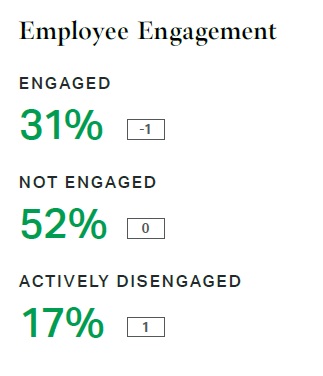
This means that two-thirds of the global workforce operates without inner drive — not because they lack skills or will, but because they no longer see meaning in the pace the system demands.
Generation Z amplifies this sentiment.
Younger employees seek flexibility, meaning, and psychological safety, while older ones increasingly feel that the price of success has become too high — time, peace, and focus.
Productivity without presence creates noise without impact.
The New Psychology of Engagement: Between Meaning and Reality
For years, we believed — and management theory told us — that engagement is driven primarily by non-material factors: purpose, belonging, recognition, autonomy.
But the new reality is more complex.
As living costs rise faster than wages, the material dimension has become mainly a hygiene factor — not because it motivates, but because its absence breeds frustration and disengagement.
And yet, human nature remains the same — we want to be heard, respected, and valued.
This doesn’t mean we should forget about meaning or emotional connection — quite the opposite.
Leaders today must balance reality and idealism: creating conditions where people feel both fairness and respect, as well as connection and purpose.
The new engagement formula is therefore not “more perks or more purpose,” but rather:
👉 Fairness + Presence + Purpose = Engagement
The Leader as Compass: Presence as the New Productivity
In times of overload, people no longer need leaders who merely push them forward, but those who know how to slow them down and guide them.
The presence of a leader has become the greatest capital of any organization —> the ability to stay focused, understand context, adapt leadership style to circumstances, calm the pace, and highlight what truly matters.
Three modern rituals of a leader — a developer of potential and a stable compass for the team:
🧘 Pause before decision: 30 seconds of mindful breathing before any major step.
💬 Weekly dialogue circle (no agenda): 30 minutes with the team — about meaning, not just goals.
🌱 Story of the month: The leader shares a personal lesson on balancing efficiency and calm.
Leadership of the future is no longer about leading faster, but about leading deeper.
Conclusion
In a world where numbers are often louder than feelings, technology moves faster than dialogue, and change is the only constant, the leader’s inner compass becomes the essential tool for long-term survival — and inspiration.
When a leader can remain calm, focused, and present, they give back to the world what it needs most — a sense of meaning.
mag. Janez Žezlina
Potentialog
📧 janez.zezlina@ecg.si